
Table of Contents
- Why Your Opening Lines Matter More Than Anything Else
- The 1 Physical Technique That Changes Everything Before You Say a Word
- 12 Proven Ways to Start a Speech That Actually Work
- How to Match Your Opening to the Moment
- Write Your First 30 Seconds: A Simple Process
- Delivery Tips So Your Opening Actually Lands
- Frequently Asked Questions About How to Start a Speech
If you want to know how to start a speech with real power, the first thing you need to understand is this: the moment you walk to that stage, you are already losing half your audience.
Not because they don’t like you. Not because your topic isn’t important. It’s because their minds are somewhere else entirely. Someone is checking their phone. Someone else is thinking about that email they haven’t sent yet. Another person is replaying an argument they had that morning.
That’s the reality you walk into every single time. And if you open your speech with “Good evening, ladies and gentlemen, it’s so great to be here,” you’ve lost them completely. They are not coming back.
Here’s the thing: knowing how to start a speech is one of the most critical skills you can develop as a speaker. Your opening doesn’t just set the tone. It decides whether people lean in or check out. And you have about 10 to 15 seconds to make that call.
I’ve been a keynote speaker for over 20 years, standing in front of audiences at Coca-Cola, AT&T, Aflac, and the U.S. Army. I’ve bombed openings. I’ve nailed them. And I’ve learned the hard way what actually works. So let me save you some of that pain.
Why Your Opening Lines Matter More Than Anything Else
Your intro should take up about 10 to 15% of your total speaking time. But those first few seconds carry almost all the weight.
Think about it this way. You walk in and the audience has been sitting there for a while. Mentally, they are not in the room. Your job, before you say a single word of substance, is to bring them back. Knowing how to start a speech the right way is how you reach into that mental fog and pull people present.
A strong opening does 3 things fast: it grabs attention, it signals credibility, and it tells people their time is worth it.
A weak opening does the opposite. And once you’ve lost them, you’re chasing them the whole time.
So the question is not just what to say. It’s how to say it in a way that makes the room stop and listen.
The One Physical Technique That Changes Everything Before You Say a Word
Before we get into specific words and techniques, let me give you something most speakers leave out entirely.
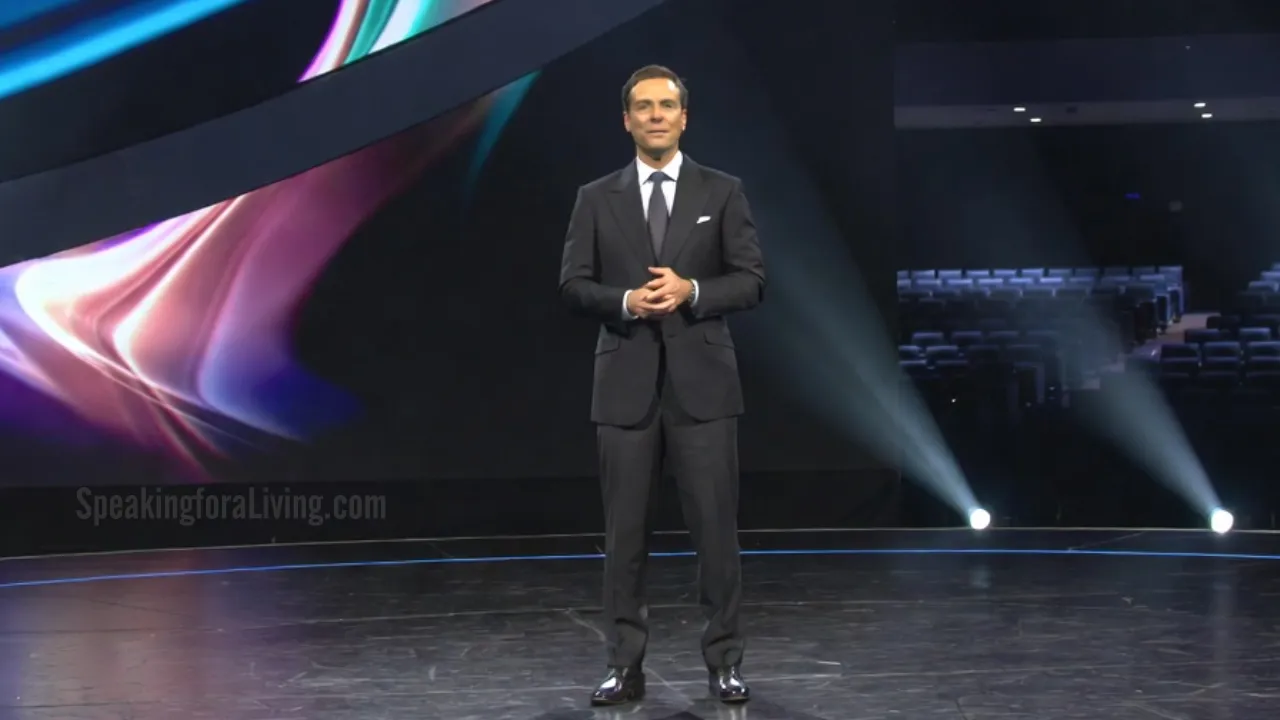
When you walk to the center of that stage, plant your feet. Don’t pace. Don’t shuffle. Don’t fidget. Plant your feet and scan the room for a couple of seconds in complete silence.
That pause is doing heavy lifting. When you pause before you speak, you are telling the audience: I am in charge of this moment. You convey power, authority, and confidence, all without opening your mouth. The room starts to quiet. People look up. And when you finally speak, they are already with you.
Get into the habit of pausing throughout your entire speech, not just at the start. A speaker who pauses is a speaker who commands.
12 Proven Ways to Start a Speech That Actually Work
1. Make a Shocking Statement
This is one of the most powerful ways to start a speech. You drop a statement that no one expected, and the room freezes.
For example: “None of you in this room is fully prepared for what Artificial Intelligence is about to do to your industry. And that’s not an insult. It’s a warning. Because surviving this disruption is going to require a new and upgraded version of yourself.”
Pause. Let it land. Then continue.
A shocking statement works because it breaks the mental autopilot people are running on. It forces them to engage immediately. Just make sure what you say is true and relevant. Shock for shock’s sake falls flat fast.
2. Ask a Thought-Provoking Question
A great question pulls the audience into the conversation before they even realize it’s happening. It makes them think. And thinking means they’re present.
The key is to ask something they haven’t already answered in their head. Not “How many of you want to be successful?” That’s too easy. Try something like, “When is the last time you did something for the very first time?” or “What would you attempt right now if you knew you could not fail?”
Let the silence sit after you ask. That silence is working for you.
3. Use a Powerful Quotation
A great quote, delivered well, can cut right to the heart of your message before you’ve explained a single thing.
Choose something short, either recognizable or surprising, and tie it directly to what you’re about to cover. Don’t read it from your phone. Know it cold. Deliver it slowly, with weight.
The quote opens the door. Your explanation walks through it.
4. Share a Short Personal Story
Stories are the oldest way humans have ever taught each other anything. They still work better than almost any other technique when it comes to how to start a speech.
Keep it short. 3 to 5 sentences. Drop the audience into the middle of the action, not the background. “I was 21 years old, standing in Miami with $5, two shirts, and not a word of English” is more gripping than a long setup about where I grew up.
Make sure the story connects directly to the point you’re making. The story is the vehicle. Your message is the destination.
5. Share a Surprising Fact or Statistic
Numbers stop people when they’re unexpected. “70% of employees say they don’t feel recognized at work” hits differently than “a lot of people feel unappreciated.”
The more specific and counterintuitive the number, the better. Just make sure you can back it up. Credibility is everything on that stage.
Add a little context right after you drop it. Give people a second to process, then tell them why it matters for them specifically.
6. Paint a Vivid “Imagine” Scenario
Start with the word “imagine” and then describe a situation so specific and relatable that people can see themselves inside it.
“Imagine you walk into work on Monday morning. Your inbox has 200 unread messages. Your boss just called a surprise all-hands meeting. And you haven’t had your first coffee yet. That’s the world most leaders are operating in, every single day.”
You are creating a shared experience in the first 30 seconds. That is a powerful thing.
7. Make a Bold or Contrarian Statement
This is different from a shocking statement. A bold contrarian claim challenges a widely held belief.
“Hard work alone is not enough.” “Your strategy is not your problem.” “The thing you think is your biggest weakness might be your most valuable asset.”
People immediately start arguing with you in their heads. Which means they’re paying attention. Just be ready to back it up with substance.
8. Use Well-Placed Humor
If it fits your personality and your audience, a light, well-timed laugh at the top of a speech can relax the room and make people feel safe enough to engage.
The risk is real though. Humor that misses lands like a lead balloon. Keep it short, keep it clean, and keep it tied to something universal. Self-deprecating humor almost always works.
If you’re not naturally funny, don’t force it. Authenticity beats a joke every time.
9. Open with a Short Video or Clip
If the room has a screen and the tech is reliable, a powerful 30-second clip can do the emotional work of establishing your theme before you say anything.
Choose something that creates feeling fast. Then step in when it ends and make the direct connection to your message. The transition from clip to voice is a strong moment when done right.
10. Acknowledge the Elephant in the Room
Sometimes the most powerful thing you can do is say out loud what everyone is already thinking.
If there were layoffs last week, if the industry just took a hit, if the company is going through a rough patch: acknowledge it directly. “I know this has been a hard season for many of you. I’m not here to pretend otherwise.”
That kind of honesty earns trust immediately. And trust is the foundation everything else gets built on.
11. Deliver a Counterintuitive Lesson Right Up Front
Most speakers save their best insight for the end. Turn that around. Lead with it.
“By the end of this hour, you’re going to see why your biggest competitors might be your best teachers.” Now the audience has a real reason to stay engaged. They want to understand how that’s possible.
You’ve set up a question in their mind. Your job for the next hour is to answer it.
12. Pose a Survey Question
Ask the audience to physically respond. Raise their hand. Stand up. Turn to someone next to them.
“Raise your hand if you’ve had to lead through a major change in the last 12 months. Keep it raised if it felt like you had no roadmap. Now look around the room.”
Physical engagement breaks the passive observer mindset. Suddenly they’re participants, not an audience. That shift matters.
How to Match Your Opening to the Moment
Not every opening works for every room. Here’s how to choose when you’re figuring out how to start a speech for a specific occasion.
Business presentations and corporate keynotes: Lead with a data point or a bold statement tied to the specific challenge that audience is facing. They want to know quickly: is this relevant to me? Make the answer obvious in your first sentence.
Motivational or leadership talks: Emotion first. A short story or a thought-provoking question works well here. You want people to feel something before they think something.
Academic or school settings: Keep it simple and grounded. A clear preview of what you’re going to cover and why it matters to them personally works well. Students tune out abstract theory fast. Make it about them.
Weddings, toasts, and special occasions: Warmth and specificity. A shared memory, a detail only you would know, something that makes people smile before you’ve made them feel anything deeper. Gentle humor works well here when it’s inclusive.
Write Your First 30 Seconds: A Simple Process
Step 1: Get clear on your 1 main message. Not 3 messages. One. What do you want people to walk away knowing or feeling?
Step 2: Choose 1 opening technique from the list above. Pick the one that fits both your personality and your audience.
Step 3: Write just 1 to 3 sentences. That is your opening. Keep it short.
Step 4: Write a bridge sentence that connects your opening directly to your first main point.
Step 5: Read it out loud. Fix anything that sounds like you’re reading instead of talking.
That’s it. Your first 30 seconds does not need to be a masterpiece. It needs to be clear, grounded, and real.
Delivery Tips So Your Opening Actually Lands
The words are only part of the equation. Here’s what actually makes or breaks how to start a speech in front of a live audience.
Make eye contact before you speak. Scan the room slowly. Find a few faces. Let them see you before you start talking.
Slow down. Most people speak twice as fast when they’re nervous. Your opening should feel almost uncomfortably slow to you. To the audience, it will feel powerful and controlled.
Project your voice from the very first word. The first word you say sets the volume for the whole speech. Start strong. Don’t warm up to it.
Pause after your hook. Drop your opening line and then stop. Say nothing for 2 to 3 seconds. Let it sit. That pause is where the impact lives.
Don’t apologize or qualify yourself. Do not start with “I know you’ve all had a long day” or “I’ll try to be quick.” That signals weakness before you’ve said anything of substance. Walk in like you belong there. Because you do.
Frequently Asked Questions About How to Start a Speech
What is a good first sentence for a speech?
The best first sentences either challenge a belief, create urgency, or put the audience inside a story. Anything that makes a person stop and think is a good first sentence for a speech. Avoid greetings, thank-yous, or anything that begins with “Today I’m going to talk to you about.”
How long should the opening of a speech be?
Your opening should be about 10 to 15% of your total speaking time. For a 30-minute speech, that’s roughly 3 to 4 minutes. But your actual hook, the very first moment that grabs attention, should land within 10 to 15 seconds.
How do I start a speech if I’m nervous?
Plant your feet, take a breath, and pause before you say anything. That pause feels long to you and powerful to them. Nerves are energy. Use them. And remember: the audience wants you to succeed. They are already on your side.
What is the most powerful way to start a speech?
There is no single answer because it depends on your audience and your message. That said, a shocking statement or a bold contrarian claim followed by a deliberate pause tends to stop rooms cold. Combine that with strong physical presence, feet planted, eye contact, and a slow delivery, and you have a powerful opening every single time.
What should you never say to start a speech?
Never open with a lengthy thank-you sequence, an apology, or “Good evening, ladies and gentlemen, it’s such an honor to be here.” That kills momentum before you have any. Also avoid starting with a joke if you’re not genuinely funny. Audiences can tell immediately.
How do you start a speech in a business or work setting?
Lead with a problem your audience is actually dealing with right now. Make it specific. “In the next 12 months, your team is going to face X. And the way you handle it will define whether you grow or plateau.” Now they’re with you because you’ve made it immediately relevant to their real life.
How do you start a speech when you blank out?
Plant your feet and take a breath. If the words leave you, the pause will buy you time. Go back to your 1 main message and start there. A simple, direct statement is always better than silence filled with panic. The audience rarely knows what you planned to say. They only know what you actually say.
The Bottom Line on How to Start a Speech
Knowing how to start a speech is not about tricks or gimmicks. It’s about respect. Respect for the fact that your audience has given you their time, and your job is to earn it from the very first second.
Plant your feet. Pause. Then open with something that actually matters.
The rest of your speech has a far better chance of landing when people are fully in the room with you from the start.
You and I know that most speakers skip that part. That’s exactly why the ones who don’t stand out every single time.

0 Comments