
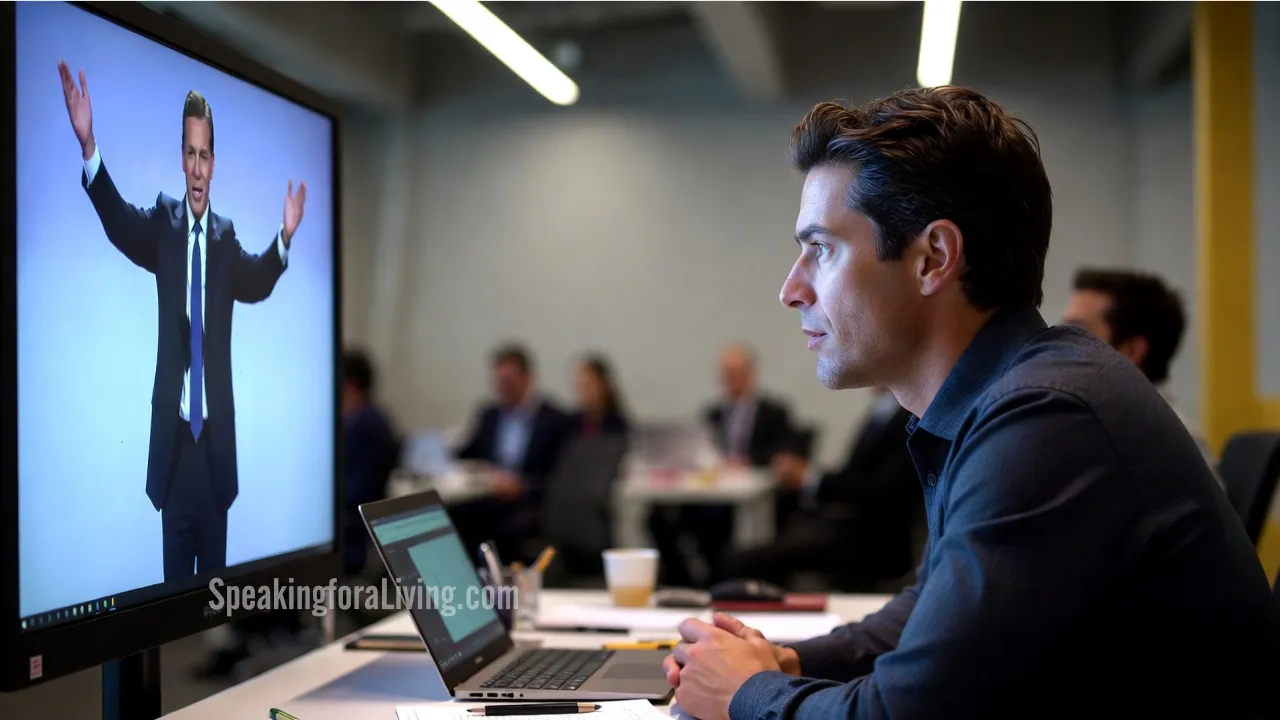
Learning how to create a speaker reel was one of the most important things I ever did for my speaking career, and I had to figure it out with no money, no professional camera, and no connections in the industry.
I was still working as a doorman at the Renaissance Waverly Hotel in Atlanta when I realized something: in the speaking world, if you don’t have a demo video, people assume you are not serious. That’s just the truth. It doesn’t matter how good you are on a stage. If a meeting planner can’t watch you speak before they book you, you are invisible.
So I had a choice. I could wait until I had the budget to hire a professional crew. Or I could find another way. You and I both know which one I chose.
What I’m going to share with you today is not a theory. It’s what I actually did, combined with what I’ve learned after 20 years speaking for companies like Coca-Cola, AT&T, Aflac, and the U.S. Army. Follow these steps and you will have a reel that opens doors. Skip them and you’ll keep wondering why the phone isn’t ringing.
Key Takeaways:
- A speaker reel is not optional. In the speaking industry, it is your first impression, your audition, and your calling card all in one.
- You do not need a big budget to start. Resourcefulness beats money at the beginning. Create a showcase, invite an audience, and get the footage.
- Your reel should be 2 to 4 minutes long, lead with a powerful hook in the first 5 seconds, and end with a clear call to action.
- Audience testimonials and client logos add credibility that no amount of self-promotion can match.
- A polished reel is an investment. Booking 1 or 2 additional gigs because of it covers the cost many times over.
- Upload your reel to YouTube and embed it everywhere. A reel no one can find is a reel that does nothing for you.
Table of Contents
- What Is a Speaker Reel and Why Do You Absolutely Need One?
- Step 1: Gather Your Best Speaking Footage
- Step 2: Script Your Reel for Maximum Impact
- Step 3: Edit Like a Pro
- Step 4: DIY vs. Professional Production
- Step 5: Optimize and Distribute Your Reel
- Common Mistakes That Kill Good Speaker Reels
- How Much Does It Cost to Create a Speaker Reel?
- Frequently Asked Questions About How to Create a Speaker Reel
What Is a Speaker Reel and Why Do You Absolutely Need One?
A speaker reel is a short video, typically 2 to 4 minutes, that shows a meeting planner or event organizer exactly what you look like on a stage. Your energy, your style, your ability to hold a room, your message. All of it compressed into a few powerful minutes.
There are 2 main types. A demo reel focuses on your keynote presentations and is the standard format for corporate and conference speaking. A sizzle reel is shorter, faster, and more emotionally charged. It is designed to generate excitement in the first 30 to 60 seconds. Both have their place, and having both is even better.
Here’s why this matters so much. Most speaking bookings start with someone watching a reel. The meeting planner is not going to read your bio first. They are not going to call you for a phone interview before they’ve seen you move. They are going to hit play and decide in the first 15 seconds whether you are worth their time.
Your reel is either opening that door or leaving it shut. There is no in between.
Feel free to watch my demo reel so you can get some ideas on how to create yours:
Step 1: Gather Your Best Speaking Footage
Here’s the thing most aspiring speakers get wrong right at the beginning: they think they need professional footage before they can make a reel. They don’t.
When I was trying to get my first demo video, I didn’t have a crew. I didn’t have a professional camera. What I had was a relationship with the general manager of the hotel where I worked, Herman Gammiter, who had heard me speak and believed in me. And I had a director of catering named Mary Jo Ferrazza who was convinced I had the talent to make it as a professional speaker.
So I went to both of them with a deal. I asked the hotel to provide the room, the food, and the drinks for a speakers showcase. In return, the speakers who participated would deliver training sessions on sales, customer service, and leadership for the hotel staff. Then the other speakers and I each chipped in to cover a two-camera video shoot. We invited anyone and everyone to fill the seats because we needed a real live audience to respond to our presentations.
After 3 months of planning and preparation, that showcase happened. And my demo video was born. It was a labor of love. That video is what allowed me to present in front of over 2,000 members of the National Speakers Association. Everything that followed came from that one decision to be resourceful instead of waiting for perfect conditions.
So start where you are. Collect phone footage from past events. Ask a friend to record your next presentation. Host your own showcase if you have to. The footage you have right now is enough to start. Quality matters, but it does not need to be perfect. It needs to be real.
Step 2: Script Your Reel for Maximum Impact
A great speaker reel is not just a collection of your best clips. It has a structure. It tells a story in 2 to 4 minutes that leaves the viewer wanting to bring you to their event.
Here is how to think about that structure.
The hook (first 5 seconds): You have to grab attention immediately. Open with your most powerful moment on stage. A line that stops people cold. A crowd reaction that shows the room was fully with you. You do not open with your name and title. That can come later. Lead with the most compelling thing you have.
The highlights (the middle section): This is where you show range. Include 3 to 5 clips that demonstrate different aspects of your speaking. Your storytelling ability. Your humor if you have it. Your ability to move a room emotionally. Your practical frameworks or teaching moments. The goal is to show that you are not a one-note speaker. You are complete.
Testimonials and social proof: Sprinkle in short clips of audience members or clients speaking about the impact you made. This is not bragging. This is letting others make the case for you. It is far more believable and far more powerful than anything you say about yourself.
The call to action (final 15 seconds): Tell them exactly what to do next. Go to your website. Send you an email. Click the link. Without a clear call to action, your reel ends and the viewer closes the tab. Don’t let that happen.
Step 3: Edit Like a Pro
The editing is where your raw footage becomes something that actually works. The good news is you don’t need to be a professional editor to do this. You need patience, honest eyes, and the right tools.
If you are just starting out and working with a tight budget, free tools like iMovie (for Mac users) and CapCut work well. They are intuitive and produce clean results. If you are ready to invest in a more professional look, Adobe Premiere and Final Cut Pro give you full control over color, audio, and transitions.
A few editing principles that matter most.
Keep cuts tight. Every second of your reel needs to earn its place. If a clip is not showing energy, credibility, or a key message, cut it. A slow reel loses viewers fast.
Fix your audio first. Bad audio will kill a reel faster than anything else. If the sound is muddy, muffled, or uneven, people stop watching. Clean audio is not optional.
Add background music. A subtle, energetic track underneath your clips adds momentum and emotion. Use royalty-free music so you don’t run into issues when uploading to YouTube or your site. Keep the volume low enough that it supports the video without competing with your voice.
Add client logos and text overlays. If you have spoken for well-known organizations, show those logos. A recognizable name on screen does a lot of work quickly. Brief text overlays naming the event or audience size also add credibility without slowing the pace.
Step 4: DIY vs. Professional Production
This is a real decision and I want to be straight with you about it.
DIY works when you are starting out. It keeps your costs down and gets you into the market faster. A well-edited self-produced reel is infinitely better than no reel at all. Do not let the perfect be the enemy of the good here.
But there is a real difference in what a professional production can do for you. I know this firsthand. Ed Primeau from Primeau Productions spent an entire day helping me put together my demo video for my keynote presentations. He did not charge me a dollar. When I asked him why, he told me he felt like he’d discovered real talent with a solid plan. He wanted to be part of it.
Not everyone is going to get that kind of generosity. But the point stands. A professional knows how to highlight your strengths, smooth out the rough edges, and deliver something that looks like you belong on the biggest stages. And when you are competing for keynote slots alongside people who have invested in their production, quality matters.
Start DIY if you need to. Graduate to professional when you can. Just start.
Step 5: Optimize and Distribute Your Reel
You can have the best speaker reel ever made. But if nobody can find it, it does nothing for you. This step is where a lot of speakers drop the ball.
Upload your reel to YouTube first. YouTube is the second largest search engine in the world. When a meeting planner searches for a speaker on your topic, you want to show up. Title your video with clear keywords: something like “Motivational Keynote Speaker Reel” followed by your name and your topic area. Write a full description with relevant terms. Add tags.
Upload it to Vimeo as well. Vimeo has a cleaner, more professional look and is often preferred for embedding on websites.
Then embed your reel in multiple places on your speaker website. The homepage. Your booking page. Your about page. Anywhere a meeting planner might land, your reel should be easy to find and play with one click.
Share it on LinkedIn. Post it in relevant communities. Send it directly to event planners you are pursuing. Your reel is your best sales tool. Use it like one.
Common Mistakes That Kill Good Speaker Reels
I’ve watched a lot of speaker reels over the years. The ones that don’t work usually fall into the same traps.
Starting too slow. If your reel opens with 20 seconds of your name, your title, and your credentials before showing you on a stage, you’ve already lost people. Lead with the best moment you have. Everything else can follow.
Poor audio quality. I said it in the editing section and I’ll say it again here because it is that important. If people can’t hear you clearly, they are not going to imagine you on their stage. Fix the audio or find different footage.
Making the reel too long. 2 to 4 minutes is the sweet spot. Beyond that, you are asking for more attention than people are willing to give. If you can’t make your case in 4 minutes, you need to edit more aggressively.
No call to action. Your reel is a marketing tool. It should tell the viewer exactly what to do when it ends. Don’t assume they will figure it out on their own. Tell them directly.
Showing only one mode. If every clip shows you doing the same thing, making the same facial expression, using the same energy level, you look like a one-trick speaker. Show range. Show humor. Show emotion. Show teaching. Show the full picture.
How Much Does It Cost to Create a Speaker Reel?
The honest answer is it depends on how you approach it.
If you go the DIY route using footage you already have and free editing software, your cost could be close to $0. Add a good microphone for future events and you are looking at $100 to $500 total.
If you hire a freelance video editor to polish your existing footage, expect to spend $500 to $2,000 depending on their experience and how much footage you have to work with.
If you hire a professional video production company to film a live event and produce a full reel, the range is typically $2,000 to $10,000.
Here’s the way I’d frame it. If your standard speaking fee is $5,000 and a strong reel helps you book 2 additional gigs this year that you would not have landed otherwise, you’ve already gotten a 10X return on a $1,000 investment. This is not a cost. It’s a business decision.
Start with what you have. Level up when you can. But do not use cost as a reason to keep waiting. I made my first demo video while I was still carrying bags as a doorman, living off tips. No condition is permanent. Right?
Frequently Asked Questions About How to Create a Speaker Reel
How long should a speaker reel be?
Your reel should be 2 to 4 minutes long. Start with a powerful hook in the first 5 seconds, feature 3 to 5 of your strongest speaking clips in the middle, and close with a clear call to action. Anything longer than 4 minutes risks losing the viewer before they make a decision.
What is the difference between a speaker reel and a sizzle reel?
A speaker reel is a comprehensive showcase of your keynote presentations, testimonials, and speaking ability. A sizzle reel is shorter, usually 60 to 90 seconds, and designed purely to create excitement and emotion. Both serve different purposes. Having both is ideal once you have the footage and budget to produce them.
Do I need professional footage to create a speaker reel?
No. Start with whatever footage you have. Phone recordings from a friend in the audience, event camera footage, even recordings of smaller workshops. The quality of your content and energy matters more than the equipment at the beginning. As your career grows, invest in better production.
What software is best for editing a speaker reel?
For beginners, iMovie on Mac and CapCut on any device are solid free options. For a more professional look, Adobe Premiere Pro and Final Cut Pro give you greater control over color, audio, and transitions. Whichever tool you use, prioritize clean audio and tight cuts over fancy effects.
How much does it cost to produce a speaker reel?
DIY production can cost anywhere from $0 to $500. Hiring a freelance editor to work with existing footage typically runs $500 to $2,000. A full professional production, including filming a live event, generally costs $2,000 to $10,000. Think of it as an investment. Booking even 1 extra gig because of a strong reel usually covers the cost.
Where should I host my speaker reel?
Upload it to YouTube first because it is the second largest search engine in the world and gives you visibility with meeting planners who are searching for speakers. Also upload to Vimeo for a clean, professional look on your website. Embed it on your homepage, your booking page, and anywhere else a potential client might land.
Can a speaker reel really help me book more speaking gigs?
Without question. Most speaking bookings start with someone watching a reel. Meeting planners are not going to take a chance on someone they cannot see in action. A strong reel shows them your energy, your message, and the kind of experience their audience will have. It makes saying yes to you much easier.
How do I get testimonials for my speaker reel?
Ask right after your events, while the emotion is still fresh. Pull out your phone and record a quick video testimonial from an audience member or event organizer before they leave the room. You can also collect written quotes from follow-up emails and display them as text overlays in your reel. Aim for variety: different industries, different roles, different ways people describe the impact you made.
The Bottom Line on How to Create a Speaker Reel
Look, I know it can feel overwhelming when you are starting out. No professional footage. No budget. No connections. I have been exactly in that place. I was a doorman carrying bags and living on tips when I organized my own speakers showcase just to get the footage I needed.
I didn’t wait for perfect conditions. I created the conditions I had with what I had. And that reel got me in front of 2,000 members of the National Speakers Association. That was the beginning of everything.
You don’t need to have it all figured out. You just need to start. Gather what you have. Script your structure. Edit it tight. Put it out into the world. And then upgrade it as you grow.
That’s how careers get built. Not by waiting. By doing.
Now it’s your turn. What’s stopping you from creating your reel this week?
Rene Godefroy is an award-winning keynote speaker who helps leaders and teams build resilience through change. He has spoken for Coca-Cola, AT&T, Aflac, Verizon Wireless, and the U.S. Army. He is the author of “Kick Your Excuses Goodbye.”
0 Comments