

You finally did it. You got your first speaking inquiry. Someone wants to book you. Then comes the question that makes your stomach drop.
"What's your fee?"
You freeze. Your mind races. You don't want to price yourself out. But you also don't want to leave money on the table. So you throw out a number that sounds reasonable. And the moment it leaves your mouth, you regret it.
Sound familiar?
This is the question I hear more than almost any other from speakers who are building their careers. And here's what I've learned after 20+ years on stages for companies like Coca-Cola, AT&T, Aflac, and Verizon Wireless: the question isn't really about the number. It's about how you see yourself.
The Real Question Behind the Question
When you ask "how much should I charge," what you're really asking is "what am I worth?"
And that's where most speakers get stuck. They look at their experience. They look at their credentials. They compare themselves to the big names. Then they talk themselves into charging less than they should.
Here's the truth. Your fee has less to do with your resume and more to do with the transformation you deliver. Event planners aren't paying for your time on stage. They're paying for the results you create in that room.
People don't pay for information. They pay for transformation.
What the Industry Actually Pays
Let me give you some real numbers so you have a starting point.
Entry level speakers who are just getting started typically charge between $2,500 and $5,000 per engagement. These are speakers building their reputation and gaining experience.
Established speakers with a solid track record and proven results charge between $5,000 and $15,000. They have testimonials, polished materials, and consistent demand.
Professional speakers who have made this their full career command $15,000 to $30,000. They've keynoted major conferences, written books, or built strong reputations in their niche.
Celebrity and high demand speakers charge $30,000 to $100,000 or more. These are household names, bestselling authors, former executives of Fortune 500 companies, and speakers with massive media presence.
Now here's what those numbers don't tell you. A speaker at $5,000 can deliver more value than a speaker at $50,000. It all depends on the fit, the message, and the ability to move that specific audience.
What Affects Your Fee
Your speaking fee isn't random. Several factors determine where you land on that scale.
Your expertise and lived experience. Have you done the thing you're talking about? Have you walked through the fire? Audiences can feel authenticity. It carries weight.
Your demand. The more people want you, the more you can charge. Simple economics.
The event type. Corporate events typically pay more than nonprofits or educational institutions. A Fortune 500 sales kickoff has a different budget than a local chamber of commerce luncheon.
The audience size. Speaking to 50 people in a boardroom is different than speaking to 5,000 at an arena. Both require skill. But the scope affects the fee.
What else you bring. Can you customize your content? Do you offer follow up resources? Will you do a workshop in addition to the keynote? These add ons increase your value.
Your materials and presence. Professional speakers have demo videos, testimonials, a solid website, and marketing assets that make the planner's job easier. This matters more than most new speakers realize.
The Mindset Shift That Changes Everything
Early in my speaking career, I had to make a decision. Was I going to apologize for my fee or stand behind my value?
I came to America with $5 in my pocket. I worked as a doorman for 14 years. I didn't have the credentials that other speakers had. No PhD. No corporate title. Just my story and my commitment to helping people see challenges as opportunities.
But I also knew something else. I had done the work. I had invested in myself. I had studied the craft. I had shown up again and again when nobody knew my name.
Your fee reflects your commitment to your own growth.
If you haven't invested in yourself, why should anyone else invest in you? If you haven't taken courses, joined associations, practiced your craft, and refined your message, your fee will reflect that.
But if you've put in the work, own it. Stand behind it.
Stop Competing on Price
Here's a mistake I see speakers make all the time. They try to win gigs by being the cheapest option.
This is a losing strategy.
When you compete on price, you attract clients who only care about price. These are not the clients you want. They'll nickel and dime you. They won't value what you bring. And they won't refer you to others.
Compete on value, not price.
What can you deliver that no one else can? What transformation do you create? What stories do you carry that will move that room in ways no one else could?
That's your competitive advantage. Not being $500 cheaper than the next speaker.
Big Mistake: The First Time I Raise My Fee
Let me tell you what happened when I raised my fee to $10,000.
I was on the phone with a potential client. They asked my fee. I said the number. And I almost choked on my own words.
Then I made the mistake most speakers make. I said, "Would that work for your budget?"
That one question told them everything. It said I was willing to negotiate. It said I wasn't sure of my own value. It invited them to push back.
Today, my fee is $20,000. And I don't flinch when I say it.
Here's what that means for you. After you quote your fee, shut up. Let them talk first. The silence might feel uncomfortable. Let it be uncomfortable. The first person to speak after the number is on the table usually loses leverage.
When someone asks your fee, say it with confidence. No apologizing. No over explaining. No wavering.
"My fee is $X. That includes a customized keynote, a pre event call to understand your audience, and follow up resources for your attendees."
Then stop talking.
If they push back, add bonuses instead of discounting your fee. Offer a follow up video. Offer signed books for attendees. Offer a Q&A session. This protects your rate while giving them more value. The moment you discount, you tell the market what you're really worth.
Now look, I know you might not be in a position to flex like this yet. I understand. When you're starting out, you need to take whatever comes your way to build experience and testimonials. I've been there.
I'll devote an entire post to fee negotiation later. But for now, here's what I want you to do.
Before every fee conversation, look yourself in the mirror. Tell yourself you are worth every penny. Say it out loud. Mean it. Because if you don't believe it, they won't either.
You deserve it.
The clients who value you at your full rate will be the best clients you ever have.
Frequently Asked Questions
Should I ever speak for free?
Yes, but be strategic about it. Early in your career, free gigs can build experience, testimonials, and referrals. But free should never be your default. If you speak for free, make sure you're getting something valuable in return. A video recording. A testimonial. Access to decision makers in the room. Referrals to paid opportunities. Free without a strategy is just free.
What if they say my fee is too high?
First, don't panic. This is normal. Ask them what their budget is. Sometimes the gap is smaller than you think. If they truly can't afford your full fee, don't discount. Add value instead. Offer a shorter session. Remove the customization. Take away the follow up resources. Or simply thank them and move on. Not every gig is your gig.
Should I charge the same fee for nonprofits?
That's up to you. Many speakers have a reduced rate for nonprofits, schools, and associations. I do sometimes adjust for organizations doing meaningful work. But here's my rule: never go so low that you resent being there. If the fee doesn't feel right, you won't deliver your best. And that hurts everyone.
How do I raise my fee?
Start with new clients. You don't have to raise your fee with everyone at once. Quote your new rate to new inquiries. As you book at the higher rate, your confidence grows. Then you can have conversations with repeat clients about your updated fee. Most will understand. The ones who truly value you will stay.
What should I include in my fee?
At minimum, include the keynote itself and a pre event call to customize your content. Beyond that, you can add travel, books for attendees, follow up resources, video messages, or breakout sessions. The more you include, the more value you deliver. And the easier it is to justify your fee.
How do I know if I'm charging too little?
If every client says yes immediately without any hesitation, you're probably too cheap. If you're fully booked but exhausted and underpaid, you're too cheap. If you feel resentment about the work, you're too cheap. A healthy speaking business has some people who say no to your fee. That's how you know you're priced right.
Do speakers bureaus take a percentage?
Yes. Most bureaus take 20 to 30 percent of your fee. That's their commission for finding you the gig and handling logistics. Factor this into your pricing. If you want to net $10,000, you need to quote higher when working through a bureau. Some speakers have a bureau rate and a direct rate. That's a personal choice.
How long does it take to reach premium fees?
There's no set timeline. I've seen speakers hit $10,000 within two years. Others take a decade. It depends on your niche, your hustle, your content, and your ability to deliver results. The speaking business is hard. It takes time to build credibility. But if you stay committed and keep improving, the fees will follow.
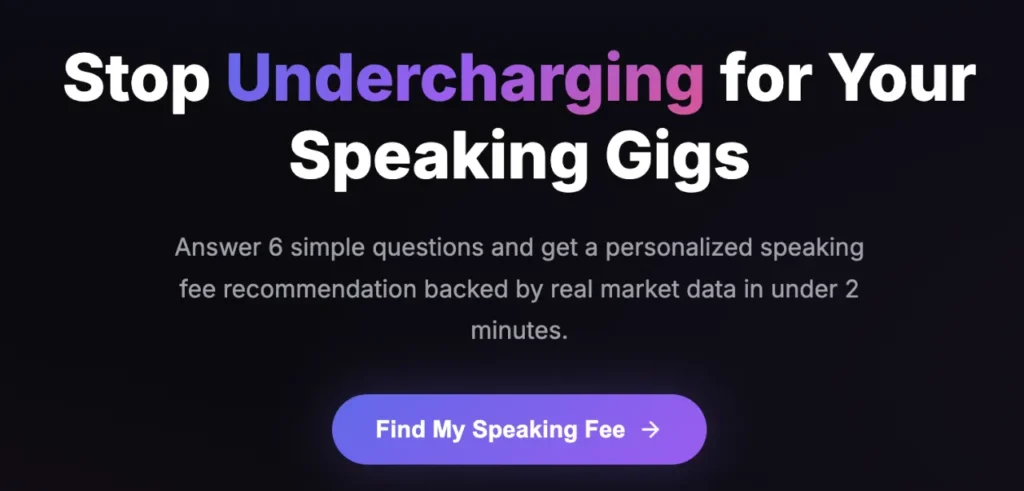
Use This Free Calculator to Find Out Your Fee
I can give you ranges all day. But the real answer depends on your specific situation.
Your experience. Your expertise. Your market. Your goals.
That's why I recommend using a tool that takes all these factors into account and gives you a customized recommendation.
Use this free Speaker Fee Calculator to find out what you should charge.
It will walk you through the key questions and help you land on a number that reflects your true value. No guessing. No second guessing yourself.
Because here's what I know for certain. You have something valuable to share. The world needs your message. And you deserve to be paid well for delivering it.
Now go find your number. And own it.
What's the biggest challenge you face when it comes to setting your speaking fee? Drop a comment below.

0 Comments